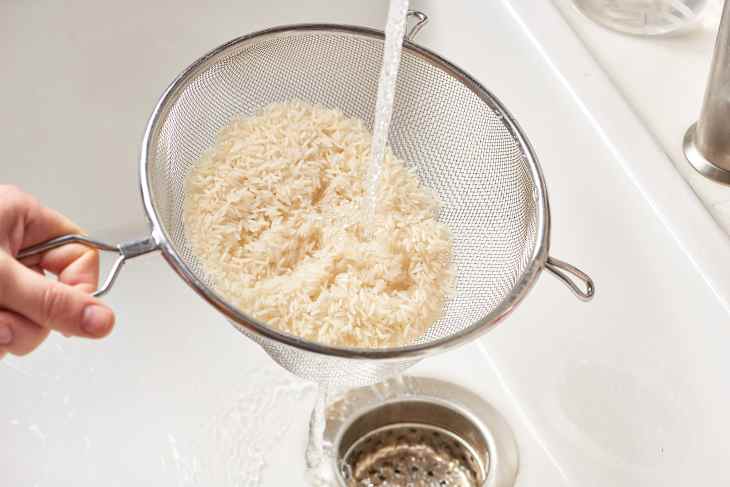
Rice — it’s a staple food in many different cuisines and the base of so many dishes. It’s hard to imagine eating black beans, beef and broccoli stir-fry, or a hearty butternut squash curry without a side of rice. Rice is delicious in many different forms and versatile enough to go with so many varying flavors.
But as ubiquitous as it is, cooking rice can be a bit of a feat. I for one personally always struggled to cook perfect rice until my mom shared her hack for getting it right every time. (If you have a rice cooker at home, maybe you don’t share in these woes.)
An essential part of the cooking process that my mom always stressed was to wash your rice before cooking it, ensuring that the water runs clear. However, I was recently talking to some Kitchn editors, and it got us wondering: Do you really need to wash rice before you cook it? Does it actually make a difference? To get the scoop, I asked some experts (seven chefs and food writers) for their takes.
What The Experts Had To Say
As I suspected, all the chefs agreed that you should rinse your rice (with a few exceptions) before you cook it. Vy Tran, food photographer and home cook, and Patricia Tanumihardja, food writer and cookbook author, both had similar experiences to mine, harking back to advice their mothers had drilled into them. Tran said, “For as long as I could remember, my mom always rinsed her rice, and it’s become a routine for me. I wash the excess starches off the rice with running water and use my fingers to rub the grains until the water is no longer cloudy.”
Tanumihardja also shared, “I was taught to rinse the rice until the water runs mostly clear, usually 3 to 4 times. This is how my mum taught me and how I taught my son, too. He’s religious about rinsing at least three times, but I have to admit that I’m sometimes lazy and stop earlier.”
Why exactly is this step necessary? Nearly all the chefs noted that it is crucial to removing any dirt, debris, or heavy metals left over from processing, as well as excess starch that might make the rice gummy. Nader Mehravari, Persian food historian, writer, photographer, and culinary practitioner, said, “Bagged or bulk rice is typically coated in a fine layer of starchy dust that accumulates during processing and transport. Washing the rice thoroughly removes this surface powder; without this step, the powder dissolves into the cooking water, creating a mushy, gooey texture rather than distinct, fluffy grains.” He also noted that these impurities can compromise the flavor of your rice. Fern Green, author of Lunch Well, agreed, saying rinsing “always gives me fluffy separated grains.”
Some take it even further. Mehravari and Reem Kassis, food and Palestinian culture author, not only wash their rice; they also soak it. “I always rinse my rice until the water runs almost clear, and usually soak it for 10–15 minutes as well, [which] just helps it cook more evenly,” Kassis says. Mehravari says that not only does this purify the rice, but “washing initiates the hydration of the grain, essentially serving as the first step of the cooking process.” This can speed up the total cooking time, too, so you may need to check it earlier than it says on the back of the package.
Working With Different Kinds of Rice
However, there’s a catch. Not all rice is created equal, so ultimately, it depends on what you’re making. While rinsing rice is generally recommended, ultimately “it depends on the rice and the goal,” says Amy Brandwein, chef and owner of Centrolina in Washington, D.C. “Jasmine and basmati rice generally requires rinsing once, while Japanese rice is best rinsed two to three times. When making risotto, you do not rinse the rice at all, as you want the starch to enhance the creaminess of your risotto. And some rice, such as Venetian black rice, Vialone Nano, requires soaking for an hour to soften the grain, allowing it to expand.”
Similarly, Mehravari recommends soaking long-grain rice varieties, such as basmati and brown rice, for the best results. With brown rice, “Because the bran layer remains intact, very little surface starch escapes into the water,” he says. So while you should still rinse it, you don’t need to remove any starch. And “since the bran acts as a physical barrier,” it could benefit from an even longer soak.
How the rice will be used can even determine how the rice is rinsed. When it comes to Cantonese clay pot rice, Lucas Sin, a chef and food blogger, says, “Most chefs wash very vigorously because [the] textural goal is separation.” Sushi rice is a little different, he adds. “Japanese masters I’ve learned from tend to advocate for restrained washing of the short-grain rice carefully enough to preserve some structural integrity and residual starch, because that’s part of what makes nigiri hold together.” Sometimes he doesn’t rinse the rice at all: “In my own experience, whenever rice is cooked in large batches (say, steamed in covered hotel pans in an oven), unrinsed rice seems to come out far more consistently.”
Ultimately, it depends on the type of rice and the application. As Mehravari says, “While rinsing isn’t strictly mandatory, it provides many rice varieties a measurable boost in quality, turning a standard side dish into a professional-grade staple.” But if you’re just cooking standard white rice at home, unless sticky rice is what you’re after, giving it a rinse is the way to go.